
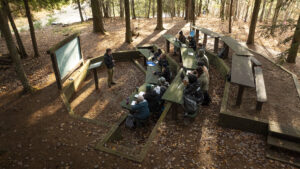
Psychology students are immersed in classes that utilize the wonders of nature and the uniqueness of the Adirondack Park. Students take advantage of an outdoor and nature-centered approach unlike any other.
Bachelor of Science / 120 Credits
While learning about the foundational principles of psychology, students will also benefit from a focus on Ecopsychology – the psychological study of human relationships within the natural world. An emphasis is also placed on the mental health and wellness benefits of being immersed in nature and the wilderness.
In addition, you’ll learn about a broad range of topics, ranging from working alongside clinical professionals exploring methods of client assessment, interviewing strategies, and therapeutic interventions to using Social Psychology to influence marketing strategies. In this program, you’ll study psychology through hands-on opportunities designed to reveal how biological, social, and psychological factors shape our lives. You’ll collaborate with faculty on research projects you design and gain professional experience through different internship opportunities.
You will:
- Learn a variety of methods that help you understand human experiences and how they connect to nature.
- Make connections between Psychology and other fields like Disaster Management Response, Outdoor Adventure Recreation, and Parks and Conservation Management.
- Develop practical advocacy skills used to promote social and environmental justice, climate change awareness, and other societal concerns.
Program Details
- Addiction and Dependency
- Sociology
- Human Development
- Social Issues
- Ecopsychology
- Abnormal Psychology
- Introduction to Therapeutic Recreation
- Psychology of Personality
- Outdoor Education Therapy Professionals
- Environmental Advocacy
- Mental Health Professions
- Social Workers
- Teachers
- HR Specialists
- Marketing
- Fund Raising
- Activism
By the end of the program students will be able to:
- Demonstrate fundamental knowledge and comprehension of the history, perspectives, concepts, and findings of psychology, such that they can explain how psychological principles apply to behavioral problems.
- Use scientific reasoning to interpret behavior, design research projects, and draw conclusions from research results.
- Act as an ethical student-scholar, recognizing their professional responsibility to respect the dignity of human and animal subjects.
|
Semester 1 |
||
|
BIO 110 |
Biology I |
3 |
|
ENG 101 |
Effective College Writing I |
3 |
|
FYS 101 |
First Year Seminar |
3 |
|
MAT 125 |
Algebra |
3 |
|
PSY 101 |
Psychology |
3 |
|
Semester 2 |
||
|
BIO 112 |
Biology II |
3 |
|
PSY 102 |
Psychology Of Personality |
3 |
|
SOC 101 |
Sociology |
3 |
|
ENG 102 |
Effective College Writing II |
3 |
|
Humanities |
3 |
|
|
Semester 3 |
||
|
MAT 210 |
Statistics |
3 |
|
PSY 210 |
Human Development |
3 |
|
SOC 200 |
Social Issues |
3 |
|
Science Elective |
4 |
|
|
Humanities |
3 |
|
|
Semester 4 |
||
|
PSY 200 |
Ecopsychology |
3 |
|
PSY 300 |
Abnormal Psychology |
3 |
|
SOC 220 |
Social Research |
3 |
|
Elective |
3-4 |
|
|
Elective |
3-4 |
|
|
Semester 5 |
||
|
PSY 310 |
Cognitive Psychology |
3 |
|
PSY 361 |
Research Methods in Psychology |
3 |
|
Science Elective |
3-4 |
|
|
Sociology Elective – UD |
3 |
|
|
Semester 6 |
||
|
PSY 330 |
Clinical Practice |
3 |
|
PSY 335 |
Social Psychology |
3 |
|
Sociology Elective – UD |
3 |
|
|
ELECTIVE – UD |
3-4 |
|
|
Elective |
3-4 |
|
|
Semester 7 |
||
|
PSYCH: Elective – UD |
3 |
|
|
PSYCH: Elective – UD |
3 |
|
|
Elective – UD |
3-4 |
|
|
Elective – UD |
3-4 |
|
|
Elective |
3-4 |
|
|
Semester 8 |
||
|
PSY 460 |
Psychology Capstone |
3 |
|
PSYCH Elective – UD |
3 |
|
|
Elective – UD |
3-4 |
|
|
Elective – UD |
3-4 |
|
|
Elective |
3-4 |
|
Where the Learning Happens
See It for Yourself

Questions? Let's get in touch.
Vance Jackson
Faculty
Associate Professor of Psychology