
Come learn about this planet’s biodiversity including how organisms function and where they live. Your biology degree can lead to jobs in museums, zoos, human health, and other fields.
Bachelor of Science / 120 Credits
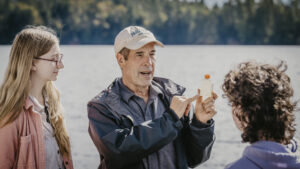
Study the inner workings of living organisms as they interact with each other and with their environment in your living lab. Situated on the shores of Lower St. Regis Lake amidst forests, lakes, streams and wetlands, we’re at the heart of a 6-million-acre wilderness known as the Adirondack Park, a designated biosphere reserve that encompasses everything from boggy wetlands to alpine forests and contains large populations of plant and animal life in natural habitat.
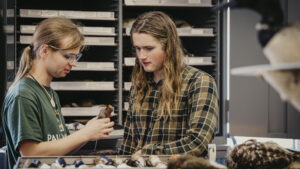
Here, you’ll gain skills to study everything from the ecology of a natural population to analyzing DNA from a microbe. You may monitor local lakes and streams for invasive species, scour the landscape for tick-borne diseases, or study how mercury affects wildlife and human health. You will learn to identify insect species or explore what lived in our lakes thousands of years ago.
Faculty and students work as teams to conduct innovative scientific research, monitoring, and outreach aimed at preserving our rapidly-changing living world. Our students study within natural habitats and engage in environmental issues first-hand, often within walking distance of their residence halls.
Program Details
- Invert Zoology or Plant Biology
- Comparative Vertebrate Anatomy
- Evolution
- General Ecology
- Organic Chemistry
- Animal Behavior
- Biochemistry
- Biologic Effects of Toxins
- Biotechnology
- Conservation Biology
- Entomology
- Herpetology
- Ichthyology
- Landscape Ecology
- Mammalogy
- Natural History of North American Vertebrates
- Ornithology
- Paleoecology
- Special Topics in Biology
Pairs well with these minors:
- GIS
- Chemistry
- Forestry
- Environmental Communication
At the end of the program students will be able to:
- Acquire a body of knowledge, including biodiversity, structure and function and ecology, and apply this knowledge to answer questions.
- Develop an ability to analyze, evaluate and synthesize scientific information.
- Effectively collaborate with others and communicate scientific information.
- Develop experimental and investigative scientific skills.
- Acquire technology skills in the study of biology.
- Consider ethical, social, economic and environmental implications of using science and technology.
|
Semester 1 |
||
|
BIO 110 |
Biology I |
3 |
|
BIO 109 |
Social Science |
3 |
|
ENG 101 |
Effective College Writing I |
3 |
|
FYS 101 |
First Year Seminar |
3 |
|
MAT 125 |
Algebra |
3 |
|
Semester 2 |
||
|
BIO 112 |
Biology II |
3 |
|
BIO 113 |
Effective College Writing II |
3 |
|
MAT 210 |
Statistics |
3 |
|
Humanities |
3 |
|
|
Elective |
2-3 |
|
|
Semester 3 |
||
|
BIO 210 |
General Ecology |
4 |
|
CHM 110 |
Chemistry I |
3 |
|
PHY 241 |
Physics I |
4 |
|
Social Science |
3 |
|
|
Semester 4 |
||
|
BIO 204 |
Plant Biology |
3 |
|
BIO 225 |
Genetics |
3 |
|
CHM 112 |
Chemistry II |
3 |
|
Humanities |
3 |
|
|
Elective |
3-4 |
|
|
Semester 5 |
||
|
BIO 320 |
Evolution |
3 |
|
CHM 250 |
Organic Chemistry I |
3 |
|
CHM 251 |
Organic Chemistry I Lab |
1 |
|
Function-Form Cluster |
3-4 |
|
|
WC-I |
Written Communication – Integrated |
3-4 |
|
Elective – UD |
3-4 |
|
|
Semester 6 |
||
|
BIO 430 |
Biostatistics |
3 |
|
Organism Cluster |
3-4 |
|
|
Elective – UD |
3-4 |
|
|
Elective |
3-4 |
|
|
Semester 7 |
||
|
Ecology Cluster |
3-4 |
|
|
Cluster Course |
3-4 |
|
|
Cluster Course |
3-4 |
|
|
Elective-UD |
3-4 |
|
|
Elective-UD |
3-4 |
|
|
Semester 8 |
||
|
SCI 495 |
Group Capstone |
4 |
|
Cluster Course |
3-4 |
|
|
Elective – UD |
3-4 |
|
|
Elective |
3-4 |
|
|
Elective |
3-4 |
|
Where the Learning Happens
See It for Yourself
Questions? Let's get in touch.
Faculty
Assistant Professor of Natural Sciences