
Students who major in Fisheries and Wildlife Science will learn to study and manage wildlife, from game to endangered species.
Bachelor of Science / 120 Credits
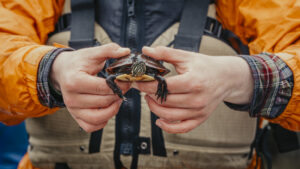
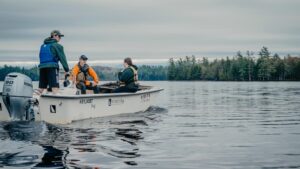
You will have hands-on opportunities to survey fish and wildlife populations and engage in activities such as small mammal trapping, fish sampling and identification, bird capture and banding, wildlife habitat assessments, and amphibian ecology studies The program is designed to meet the biologist certification requirements of the American Fisheries Society or The Wildlife Society. This is a challenging program that requires you to be proficient in science and math as a foundation for conducting research.
You will:
- Acquire skills in the identification of organisms.
- Focus on invasive species, habitat fragmentation and degradation, climate change, and more.
- Work with faculty and local biologists on fisheries and wildlife research.
- Develop skills a practicing fisheries and wildlife scientist would use during their career.
- Participate in long-term monitoring projects.
- Participate in the Smitty Creek Watershed monitoring and research project.
- Collaborate with the Paul Smith’s Visitor’s Interpretive Center.
Program Details
- Foundations of Fisheries and Wildlife Sciences
- Techniques in Fish and Wildlife
- Watershed Management
- Limnology
- Forest Soils
- Ichthyology, Ornithology, Mammalogy, and Herpetology
• Fisheries/Wildlife technician, biologist or manager
• Conservation biologist
• Ecologist
• Public educator and outreach specialist
• Wildlife law enforcement officer
• Game warden
• Wildlife consultant
• Research Scientist
At the end of the program students will be able to:
- Apply science as a body of knowledge and as a method of inquiry.
- Apply key concepts of biology, ecology, physics, and chemistry to fisheries and wildlife organisms, populations, communities, and their habitats.
- Apply basic math skills to problem-solving in fisheries and wildlife populations and their habitat.
- Discuss how anthropogenic issues affect the dynamics of fish populations, communities, and their habitats.
- Articulate scientifically a rationale and justification for assessing and monitoring the effects of major issues on fish and wildlife populations, communities, and
their habitat. - Apply gained knowledge of assessment and monitoring protocols to evaluate the effects of major issues on fish and wildlife populations, communities, and their habitats.
- Apply appropriate techniques for studying, analyzing, and assessing fish and wildlife populations.
- Delineate the management environment in ecological, economic, political, and socio-cultural terms.
- Articulate the appropriateness of management approaches used to address the issues and problems affecting fisheries and wildlife, their habitats, and humans.
|
Semester 1 |
||
|
BIO 110 |
Biology I |
3 |
|
ENG 101 |
Effective College Writing I |
3 |
|
FWS 109 |
Foundations Fisheries & Wildlife Management |
3 |
|
FYS 101 |
First Year Seminar |
3 |
|
MAT 125 |
Algebra |
3 |
|
Semester 2 |
||
|
BIO 112 |
Biology II |
3 |
|
ENG 102 |
Effective College Writing II |
3 |
|
MAT 180 |
Precalculus |
3 |
|
Humanities |
3 |
|
|
Social Sciences |
3 |
|
|
Semester 3 |
||
|
BIO 210 |
General Ecology |
4 |
|
CHM 110 |
Chemistry I |
3 |
|
FWS 270 |
Natural History of North American Vertebrates |
3 |
|
|
Humanities |
3 |
|
Semester 4 |
||
|
BIO 225 |
Genetics |
3 |
|
CHM 112 |
Chemistry II |
3 |
|
GIS 201 |
Introduction To GIS |
3 |
|
MAT 210 |
Statistics |
3 |
|
|
Social Sciences |
3 |
|
Semester 5 |
||
|
ENV 315 |
Environmental Law & Regulatory Process |
3 |
|
Ecology Cluster |
3-4 |
|
|
FWS 332 |
Fisheries Techniques |
3 |
|
|
Zoology Cluster |
3-4 |
|
Physical Science Cluster |
3-4 |
|
|
Semester 6 |
||
|
ENV 330 |
Conservation Biology |
3 |
|
FWS 471 |
Wildlife Management |
3 |
|
or FWS 481 |
Fisheries Biology Management |
3 |
|
Ecology Cluster |
3-4 |
|
|
Zoology Cluster |
3-4 |
|
|
ELECTIVE – UD |
3-4 |
|
|
ELECTIVE – UD |
3-4 |
|
|
Semester 7 |
||
|
|
Botany Cluster |
3-4 |
|
Ecology Cluster |
3-4 |
|
|
Zoology Cluster |
3-4 |
|
|
ELECTIVE – UD |
3-4 |
|
|
ELECTIVE – UD |
3-4 |
|
|
Semester 8 |
||
|
FWS 472 |
Applications in Fisheries & Wildlife |
4 |
|
ELECTIVE – UD |
3-4 |
|
|
ELECTIVE – UD |
3-4 |
|
|
ELECTIVE – UD |
3-4 |
|
Where the Learning Happens
See It for Yourself
Questions? Let's get in touch.
Faculty
Professor of Ecology & Aquatic Science