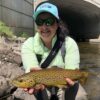
Dr. Emily Grausgruber is a fisheries biologist whose research examines species interactions, aquatic food webs, and population dynamics. She has worked in diverse systems, including the St. Lawrence River, the Iowa Great Lakes, and Lake Oahe, studying organisms ranging from zooplankton to sportfish. Her work integrates field studies, experimental manipulation, and modeling to address applied fisheries management questions and fundamental ecological processes. Her research interests include the roles of predation, competition, invasive species, aquaculture and stocking practices, and temporal changes in fish populations.
Academic
- 2020 Ph.D. Iowa State Biology, Fisheries Biology
- 2013 M.S. Clarkson University, Environmental Science & Engineering
- 2010 B.S. State University of New York at Potsdam, Biology
Teaching
- Adjunct Instructor, Fundamentals of Mathematics (MTH 090) SUNY Jefferson, Spring 2021
- Guest Lecturer, Fisheries Techniques (A ECL 333), Iowa State University, Falls 2015-2018, 2020
- Guest Lecturer, Fisheries Management (A ECL 440), Iowa State University, Falls 2015-2018, 2020
- Teaching Assistant, Vertebrate Biology (A ECL 365), Iowa State University, Fall 2018
- Co-Instructor, Fish Physiology Seminar (NREM 305), Iowa State University, Spring 2018
- Teaching Assistant, Vertebrates of Iowa (A ECL 366), Iowa State University, Spring 2017
- Teaching Assistant, Principles of Biology (BIOL 198), Kansas State University, Spring and Fall 2014
- Teaching Assistant, Human Biology (BIOL 107), State University of New York at Potsdam, Fall 2009
Dr. Grausgruber uses an integrated research approach that incorporates natural field experiments, experimental manipulation, and modeling to address applied fisheries questions and fundamental ecological processes. Her research interests span several interconnected areas, including the influence of competition, predation, keystone species, movement patterns, and invasive species on fish population dynamics and aquatic ecosystems; the effects of aquaculture and stocking practices on ecosystem function; temporal changes in fish populations examined through a range of modeling approaches; and the evaluation of teaching techniques used in education programs. Collectively, this work advances understanding of aquatic ecosystem structure and function, strengthens fisheries ecology and management, and supports the training of future fisheries professionals.
As an educator, Dr. Grausgruber is deeply committed to developing and delivering hands-on science courses. She continually adapts her instructional style to meet the evolving needs of students while aligning with current teaching paradigms. Drawing on her own experiences in supportive, engaging academic environments, she strives to foster inclusive classrooms that challenge students and encourage both scientific and personal growth.
Grausgruber, S.J., Grausgruber, E.E., Weber, M.J. In review. Evaluation of physiological consequences of ice angling on Bluegill Lepomis macrochirus. Fisheries Research.
Grausgruber, E.E., Weber, M.J. In press. Using mark-recapture techniques to assess fall survival of fall stocked walleye Sander vitreus in two Iowa lakes. Fisheries Research.
Grausgruber, E.E., Weber, M.J. In press. Shift happens: evaluating the ability of fall stocked walleye Sander vitreus to shift to natural prey. Fisheries Ecology and Management.
Grausgruber, E.E., Weber, M.J. In press. Experimental evaluation of transport distance on stress and mortality of age-0 Walleye Sander vitreus. Journal of Wildlife and Fisheries Management. https://doi.org/10.3996/JFWM-20-046
Grausgruber, E.E., Weber, M.J. 2021. Using bioenergetics to estimate consumption of stocked age-0 Walleye Sander vitreus by a suite of piscivores. North American Journal of Fisheries Management. 41:344-354. https://doi.org/10.1002/nafm.10523
Grausgruber, E.E., Weber, M.J. 2020. Bigger is better! Evidence of size-selective predation on age-0 Walleye Sander vitreus. North American Journal of Fisheries Management. 40:726-732. https://doi.org/10.1002/nafm.10437
Grausgruber, E.E. 2020. Looking for a bottleneck: Assessment of factors influencing post-stocking survival of advanced fingerling Walleye Sander vitreus (Dissertation). Iowa State University. https://doi.org/10.31274/etd-20200624-120
Weber, M.J., Weber, R., Ball, E.E., Meerbeek, J. 2020. Behavior and survival of stocked fingerling Walleye in three Iowa, USA lakes. North American Journal of Fisheries Management. 40(1): 48-60. https://doi.org/10.1002/nafm.10403
Ball, E.E., Weber, M.J. 2019. Effects of transport duration and water quality parameters on age-0 Walleye Sander vitreus stress and survival. North American Journal of Aquaculture. 82(1): 33-42. https://doi.org/10.1002/naaq.10114
Ball, E.E., Weber, M.J. 2018. Biometric relationships between Walleye Sander vitreus total length and lengths of external morphometric features. Journal of Applied Ichthyology. 34(6): 1277-1284. https://doi.org/10.1111/jai.13782
Blankman+, T., Ball, E.E., Weber, M.J. 2018. Evaluating the efficiency of pulsed gastric lavage for fingerling Walleye Sander vitreus. North American Journal of Fisheries Management. 38(4): 953-958. https://doi.org/10.1002/nafm.10202
Ball, E.E., Smith, D.E., Anderson, E.J., Skufca, J.D., Twiss, M.R. 2018. Delineating nearshore and main channel environments in the Upper St. Lawrence River: Plankton community assessment in a large river system. Hydobiologia. 185 (1): 125-140. https://doi.org/10.1007/s10750-018-3556-5
Ball, E., Adams, D., Dupuie J., Eeling, J., Hudson, Z., Jones, M., Kirk, B., McCombs, A., McGovern, P., Rabinowitz, A., Ruden, R., Schmidt, S., Thompson, K., Vaziri, G., Klaver, R. 2017. Serendipity: An ecologist’s quest to understand nature. Journal of Mammalogy. 98(5): 1509-1510. https://doi.org/10.1093/jmammal/gyx108
Ball, E.E., Weber, M.J. 2017. Validating a diabetic glucose meter to assess walleye Sander vitreus glucose concentrations. North American Journal of Aquaculture. 79(3): 245-249. https://doi.org/10.1080/15222055.2017.1310158
Ball, E.E., Twiss, M.R. 2013. Plankton assemblages in low velocity and high velocity regions of the Upper St. Lawrence River (Master’s Thesis). Clarkson University.