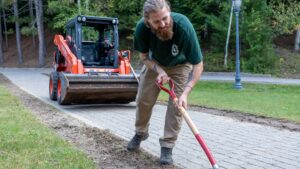
Valorie Titus’ passion for fieldwork and wildlife has translated to teaching expertise
One of Valorie Titus’ most visceral experiences with wildlife was shocking, but not because she was electrofishing to survey species at the time. While wading through the Bronx River surveying snapping turtles and other species, she bumped into a firearm magazine. One of her students nearby saw it as well, wondering whether they’d find a gun nearby. Soon enough, they found a Glock that was later connected with a shooting in New York City.
“Urban ecology is amazing,” said Titus, who confesses she had the local precinct of the New York Police Department on speed dial during her ecological work on the Bronx River.
Despite her gritty urban work in the Bronx, Titus grew up in a small town in upstate New York near Binghamton, where she hunted and fished with her mother, uncle and stepfather. She spent lots of time at her uncle’s cabin in the Catskills, where the television only had a single channel, so she went outdoors to catch tadpoles and small fish.
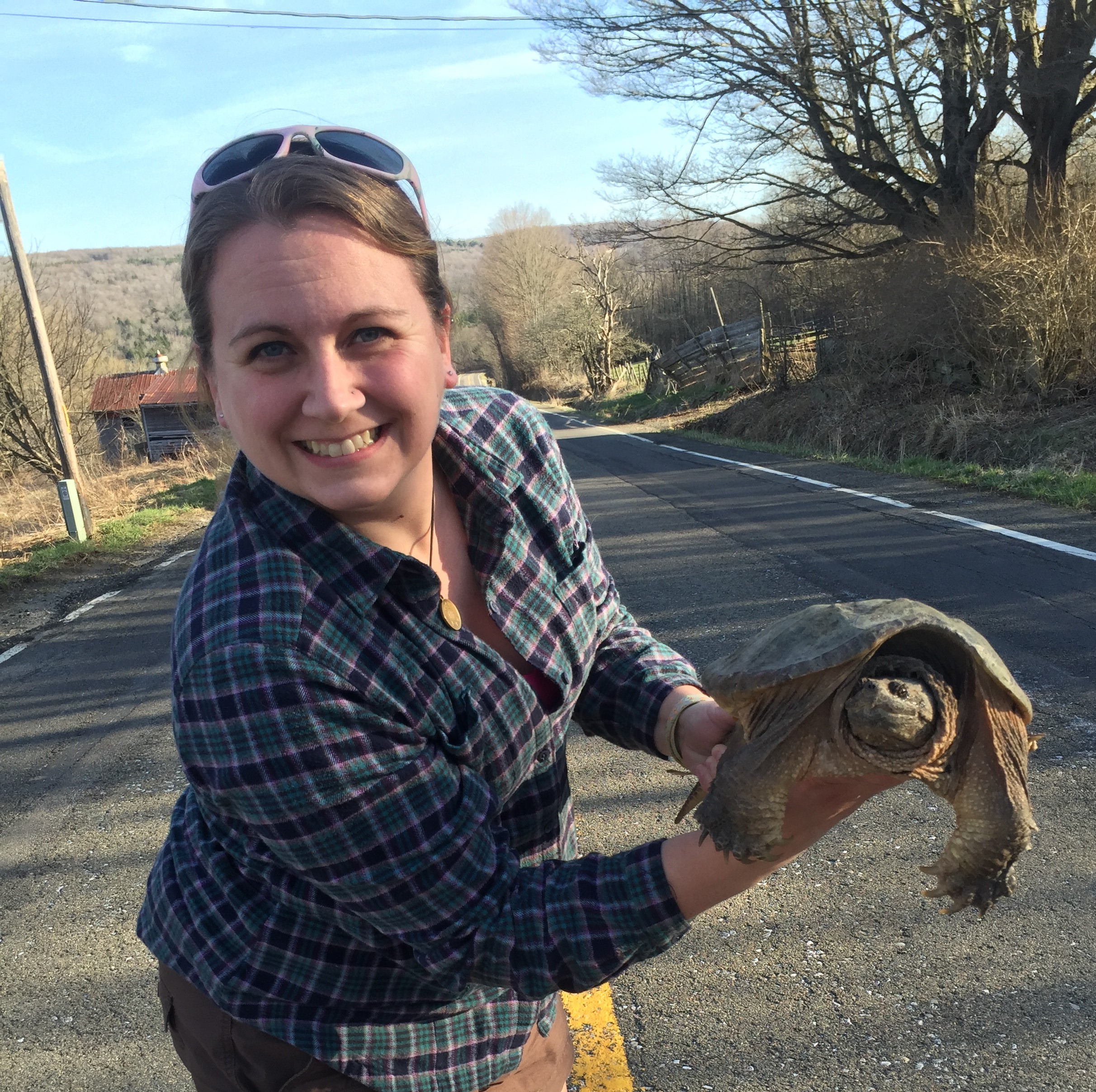 Titus was always drawn to animals. She carried field guides with her and wanted to be a paleontologist and a zoologist when she grew up. “My two loves as a child were dinosaurs and wolves,” she said. Her sister was more into collecting dolls, “My dinosaurs would attack her Barbies.”
By high school, she liked science and had a great biology teacher, but sports were the main driver of her choice in college. She attended Cazenovia College, a small private college in New York state that recently closed due to financial challenges. “I jokingly say I majored in athletics and minored in science,” she said.
Nonetheless, she had great mentors in wildlife ecology and decided to pursue graduate school. She had begun to yearn for something a little less routine after interning at the Rosamond Gifford Zoo in nearby Syracuse as a keeper during her junior year at Cazenovia.
Titus enrolled in Murray State University to study paleontology and dove into fieldwork before classes even started. She went on a dig in Kansas, unearthing small mammal fossils from the early Pleistocene. The work was hot but fun. “It really felt like [we were] in the middle of nowhere,” Titus said.
From the Dead to the Living
She quickly found out that she lacked a vital characteristic for paleontology–a strong stomach. Looking through microscopes at tiny pocket gopher and mice fossils for hours on end gave her motion sickness. She had a heart-to-heart with her advisor and decided to switch her focus toward working with living creatures instead.
The only professor at Murray with an opening was in the herpetology department, a professor working with copperheads (Agkistrodon contortrix). “I was a little nervous,” she said, but she quickly became hooked. She may have even gotten a little too confident, routinely wearing sandals during night surveys along the roadside looking for snakes. But the only time she came close to getting bitten by a dead snake in the middle of the road whose muscles still had some twitch was the day she wore boots. The copperhead only hit a bit of the rubber.
For her graduate project, she looked at copperhead roadkill at Land Between the Lakes National Recreation Area in Kentucky. “They were less likely to cross the busy roads but more likely to get hit on the busy roads,” she said.
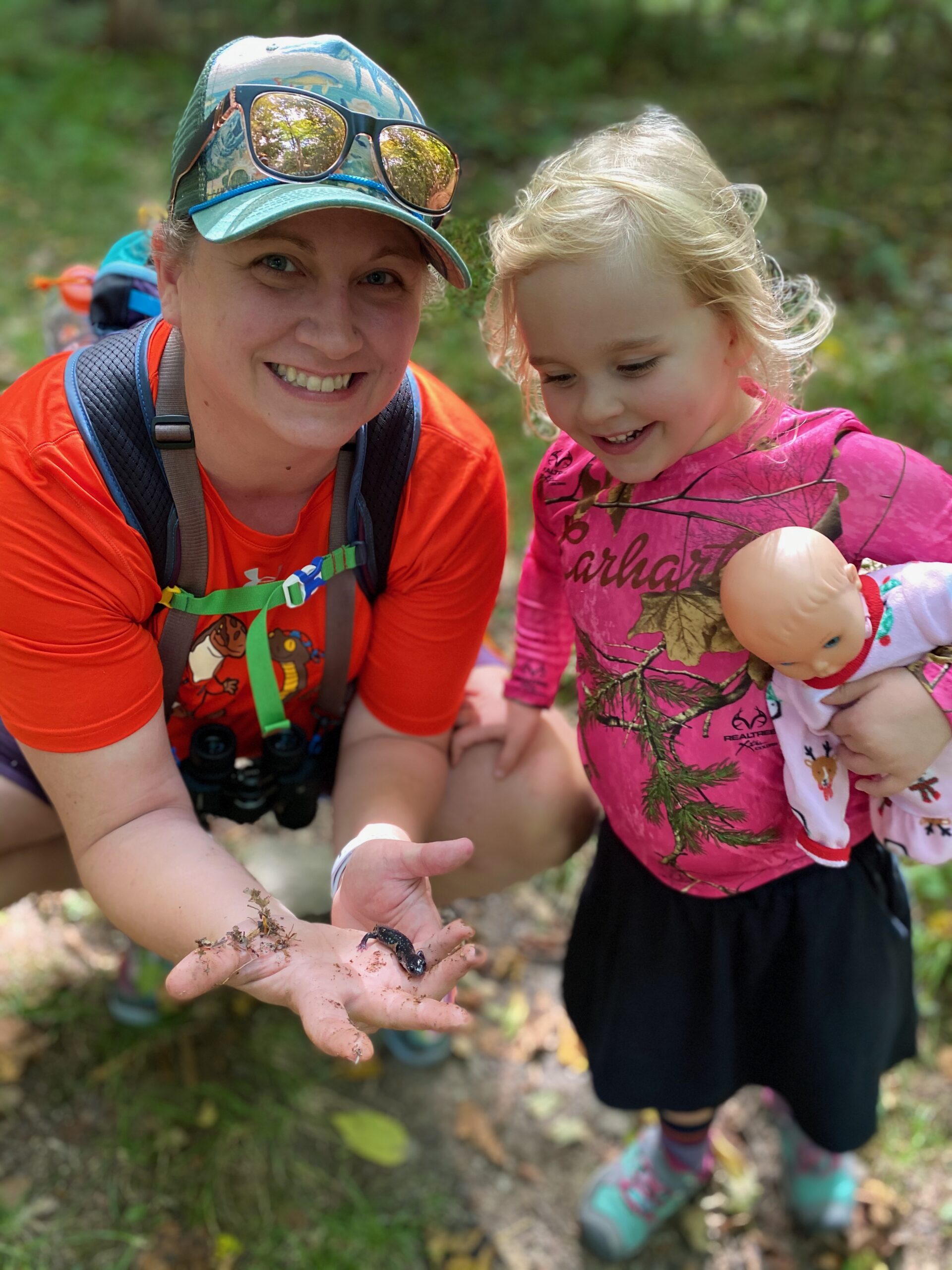 At Murray, Titus also joined The Wildlife Society’s student chapter. She loved the camaraderie and the great professors, as well as going to talks. While enrolled, Murray also hosted TWS’ Southeastern Student Conclave-an experience that would inspire her future involvement with TWS.
As graduation neared, Titus began to miss her northeastern home. She enrolled in Binghamton University for her PhD and worked with TWS member Tim Green on eastern tiger salamanders (Ambystoma tigrinum) on Long Island. The species, listed by the New York State Department of Environmental Conservation, didn’t have a management plan yet. To fill in some gaps for the state agency on Long Island, Green helped her access several thousand acres of protected land around Brookhaven National Laboratory, a Department of Energy facility on Long Island whose main focus is on physics projects-where the species is abundant.
Using Brookhaven as a base, Titus conducted radiotelemetry work on salamanders and had undergraduate interns working with her. “It was overall one of the best professional experiences I ever had,” she said.
While he was her supervisor, Green was also TWS’ New York Chapter president. Titus became more involved in the chapter, becoming the communication chair and the editor of the chapter’s newsletter. She also became more involved in the larger organization. At the time, TWS member John McDonald was putting together a field course and needed instructors. Titus volunteered to teach herpetology, and later hunter’s safety, quickly discovering that her true calling in wildlife was teaching. She loved mentoring students and giving them better opportunities than she had.
Finding Her Calling
While finishing her PhD, Titus took a job at the Bronx Zoo working in the herpetology department. She conducted surveys in the Bronx River, where she tracked species like common snapping turtles (Chelydra serpentina) and nonnative red-eared sliders (Trachemys scripta elegans), as well as fish. “The diversity of fish we found even in the Bronx River at that point was pretty cool,” she said.
But her surveys also turned up dead dogs, homeless men urinating into the river and the one time, a gun. Despite her experience with the snake bite, Titus still made mistakes when it came to dressing safely for fieldwork, admitting she probably should have worn waders more often in the Bronx River.
When her two-year position at the Bronx Zoo ended, Titus spent a year in Montana with the Wildlife Conservation Society studying bison (Bison bison). She also participated in TWS’ Leadership Institute in 2012. After finally defending her PhD in 2013, she then landed a teaching job at Green Mountain College, where she started a TWS student chapter. She’d enjoyed her experience at the Southeastern Student Conclave while at Murray so much that the fledgling chapter soon hosted the North-east Student Conclave.
Like her undergraduate Cazenovia College, Green Mountain also soon closed. Titus found a job at Keystone College in Pennsylvania, where she started a TWS student chapter. However, the COVID-19 pandemic and “delusions of grandeur” made her move into an administrative position as program director of wildlife management at Hocking College in Ohio. While she said the program was excellent, she preferred teaching to administration, and in 2023 she landed a job teaching at Paul Smith’s College in the Adirondacks in New York state.
She got right back to work with TWS, reviving the Northeast Student Conclave in 2025, which hadn’t happened for six years. Meanwhile, she is mentoring four graduate students who are studying hunting culture, vernal pools and monitoring black bears (Ursus americanus) and canids in the Adirondacks with trail cameras. “If my only contribution to conservation is the quality of students I put out into the real world, then it’s a pretty damn good contribution,” she said.
Erika Schwoyer has known Titus since she was an undergraduate at Keystone. “She was so passionate about getting us involved in The Wildlife Society and getting us to go to conferences,” Schwoyer said. “Professionally, she’s just involved in so many things, and that just inspired me to be also involved in a lot more things.”
Schwoyer followed Titus to Paul Smith’s to conduct her master’s in natural resources. “[Titus] definitely is somebody that I look up to a lot,” she said.
At 46, Titus’ career is really just getting started. She has a youthful energy-on a field trip with her herpetology class in Francis Marion National Forest in South Carolina in 2024, she challenged her students to find a greater siren (Siren lacertina), a highly elusive amphibian rarely seen in the area. “If you catch one, I’m going to get a tattoo of it,” she told them, never expecting it to happen. But one turned up in a turtle trap the class set up in a swamp. The only reason she hasn’t gotten the tattoo yet is she was looking for a depiction she liked enough to get permanently done. She’s since found one that she plans to get on her ankle-“bottom dwellers,” she explained.
This article was reprinted in the Fall 2026 issue of the Paul Smith’s College Magazine with permission from the Winter 2026 Issue of The Wildlife Professional, a publication of The Wildlife Society.