QUEENSBURY, N.Y. – Paul Smith’s College Adirondack Watershed Institute (AWI) stewards intercepted invasive hydrilla, one of the region’s most concerning aquatic invasive species, on a boat that stopped at the Adirondack Welcome Center prior to entering the Adirondack Park. The discovery stopped the plant from reaching another Adirondack waterbody and underscored the importance of ongoing efforts to protect the region’s lakes and rivers.
It was one of several significant interceptions during a record-breaking 2026 season for AWI. Working in partnership with the New York State Department of Environmental Conservation (DEC) and the Lake Champlain Basin Program (LCBP), AWI stewards staffed more than 60 boat launches and decontamination sites across the Adirondack Park. Over the course of the season, they engaged with 159,628 visitors and inspected 83,466 vessels.
Of the watercraft inspected, 1.2% were transporting aquatic invasive species, a slight increase from last year. Stewards performed 4,541 hot water decontaminations, representing 5.4% of all inspections and the highest percentage in the program’s history.
The hydrilla interception underscores why that work matters. Aquatic invasive species can spread quickly when transported on boats, trailers and equipment. Once established, they can alter aquatic ecosystems, disrupt recreation and require costly, long-term management.
Hydrilla was not the only invasive species stewards kept out of Adirondack waters this season. Inspections also identified and intercepted Eurasian watermilfoil, variable-leaf milfoil, zebra mussels, fanwort, brittle naiad, spiny/fishhook waterfleas, quagga mussels, curly-leaf pondweed and water chestnut.
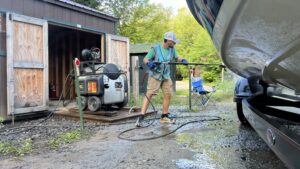
When invasive species are discovered, stewards use specialized decontamination equipment that delivers water heated to 120–140 degrees Fahrenheit to neutralize organisms before a vessel enters another waterbody. They also collect data that helps guide future prevention efforts and work directly with boaters to reinforce the “Clean, Drain, Dry” practices that help stop invasive species from spreading.
AWI manages the largest aquatic invasive species spread-prevention program east of the Mississippi River. Its reach is strengthened by partnerships with New York State, LCBP, environmental organizations and lake and watershed associations throughout the Adirondack Park.
“The Lake Champlain Basin Program and the Paul Smith’s College Adirondack Watershed Institute have had a long-standing and critical partnership working together to prevent the spread of aquatic invasive species,” said Meg Modley, LCBP Aquatic Invasive Species Management Coordinator. “The two programs train staff together, collect the same data and even wear the same uniforms to ensure that boaters coming to the Adirondack region receive the same ‘Clean, Drain, Dry’ messaging, watercraft inspections and decontamination procedures such that our programs are viewed as one.”
“We want to thank all the boaters who helped make this season a success,” said Brett Wimsatt, Director of the AWI Stewardship Program. “Boaters throughout the Adirondack Region have grown accustomed to seeing blue-vested stewards at boat launches. The growth in our program’s effectiveness from year to year is largely a product of boaters experiencing consistent steward interactions and adopting ‘Clean, Drain, Dry’ best practices themselves.”
About Paul Smith’s College:
At Paul Smith’s College, it’s about the experience. As the only four-year institution of higher education located in the Adirondack Park in upstate New York, Paul Smith’s provides real-world, hands-on learning in fields such as business and hospitality, culinary management, forestry, environmental sciences, and natural resources. We can draw on industries and resources available in our backyard while preparing students for successful careers anywhere. Our community of resourceful, enterprising, supportive, and adventurous individuals collectively provides experiential education, student support in the classroom and beyond, and meaningful opportunities for our alumni. We pride ourselves on research and advocacy on issues that improve our planet and the lives of the people who inhabit it. Learn more at www.paulsmiths.edu.
The mission of the Adirondack Watershed Institute is to protect clean water, conserve habitat, and support the health and well-being of the people in the Adirondacks through scientific inquiry, stewardship, and real-world experiences. Learn more at adkwatershed.org
Media Contact:
Ben Brosseau, Director of Communications, Paul Smith’s College
bbrosseau2@paulsmiths.edu, 518-327-6031