
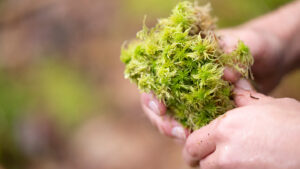
Engage with a diverse range of ecosystems, tackle real-world environmental challenges, develop practical skills, and foster a deep appreciation for nature—all right inside the 6 million acre Adirondack Park.
Bachelor of Science / 120 Credits
Because our beautiful campus is surrounded by lakes, streams, and forests, you can unlock a world of opportunity and make a positive impact on our planet with a Bachelor of Science in
Environmental Sciences.
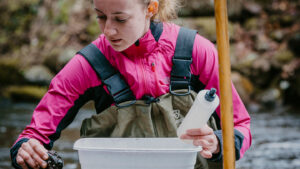
You’ll gain the knowledge and skills to identify, monitor, and implement solutions to tackle pressing environmental issues and challenges stemming from human interactions with the environment. Our Environmental Sciences program is founded on a philosophy that experiential education provides a means and model for deeper, effective learning, and as a means for personal and professional development. From your first days on campus, you will learn in the classroom—and in the field.
Our faculty are dedicated to our students. Our learning process is treated as a collaborative experience among faculty and students, where you, as a student, actively participate in all stages of learning. You will have opportunities to customize your program of study to focus on your interests and goals. There are many opportunities for summer employment, internships, and study abroad to help round out your program.
Program Details
- General Ecology
- Organic Chemistry
- Environmental Chemistry
- Conservation Biology
- Politics of the Environment
- Ecosystems: Atmospheric Science
- Soils and Hydrology
- Landscape Ecology
- Limnology
- Stream Ecology and Management
- Watershed Management
- Wetlands Ecosystems and Management
- Environmental Microbiology
- Biologic Effects of Toxins
- Geographic Information Systems: Introduction to Remote Sensing
- Advanced GIS Techniques
- Environmental Policy and Planning: Environmental Impact Assessment
- Environmental Law and Regulatory Processes
- Sustainable Development
- Environmental Scientist
- Conservation Officer
- Environmental Journalist
- Environmental Educator
- Environmental Planner
- Climate Change Analyst
- Renewable Energy Specialist
- Water Quality Specialist
- Research Scientist
- Environmental Lawyer
At the end of the program students will be able to:
- Describe the physical environments and biological communities that characterize terrestrial and aquatic environments.
- Describe the physical, chemical, and biological processes that govern the flow of energy and material resources in air, water, and soil.
- Apply science as a body of knowledge and as a method of inquiry in research.
- Apply basic statistics to problem solving and hypothesis testing.
- Be able to access and synthesize scientific literature to gain a comprehensive understanding of issues on environmental quality.
- Develop a scientific rationale for assessment of problems affecting environmental quality.
- Apply assessment and monitoring techniques to data collection, quality assurance & quality control, and analyses.
- Articulate scientific findings in oral and/or written forms.
- Describe management approaches that appropriately address environmental issues (e.g., adaptive management, ecosystem management, best management practices).
- Delineate influential factors in environmental management (e.g., ecological, economic, political, and socio-cultural) and delineate the basic steps in the management process (e.g. assessment, implementation of action, and evaluation).
- Articulate the role of law and regulatory process in the protection, maintenance, and restoration of the environment (e.g., Clean Water Act).
- Develop the skills needed to effectively work with a variety of stakeholders in an interdisciplinary management setting as an integrated team.
|
Semester 1 |
||
|
BIO 110 |
Biology I |
3 |
|
ENG 101 |
Effective College Writing I |
3 |
|
ENV 110 |
Foundations of Environmental Science |
4 |
|
MAT 125 |
Algebra |
3 |
|
FYS 101 |
First Year Seminar |
3 |
|
Semester 2 |
||
|
BIO 112 |
Biology II |
3 |
|
ENG 102 |
Effective College Writing II |
3 |
|
Humanities |
3 |
|
|
Social Science |
3 |
|
|
Elective |
3 |
|
|
Semester 3 |
||
|
BIO 210 |
General Ecology |
4 |
|
CHM 110 |
Chemistry I |
3 |
|
PHY 241 |
Physics I |
4 |
|
POL 202 |
Politics Of The Environment |
3 |
|
Semester 4 |
||
|
CHM 112 |
Chemistry II |
3 |
|
GIS 201 |
Intro to GIS |
3 |
|
MAT 210 |
Statistics |
3 |
|
Elective |
3 |
|
|
Elective |
3-4 |
|
|
Humanities-LAS |
3-4 |
|
|
Semester 5 |
||
|
CHM 250 |
Organic Chemistry I |
3 |
|
Ecosystem Cluster |
3-4 |
|
|
Ecosystem Cluster |
3-4 |
|
|
Elective |
3-4 |
|
|
Elective |
3-4 |
|
|
Semester 6 |
||
|
CHM 311 |
Environmental Chemistry |
3 |
|
Policy Plan Cluster |
3-4 |
|
|
Elective – UD |
3-4 |
|
|
Elective – UD |
3-4 |
|
|
Semester 7 |
||
|
Ecosystem Cluster |
3-4 |
|
|
Ecosystem Cluster |
3-4 |
|
|
Policy Plan Cluster |
3-4 |
|
|
Elective – UD |
3-4 |
|
|
Elective |
3-4 |
|
|
Semester 8 |
||
|
SCI 462 |
Independent Capstone Project |
3 |
|
Ecosystem Cluster |
3-4 |
|
|
Ecosystem Cluster |
3-4 |
|
|
Elective |
3-4 |
|
Where the Learning Happens
See It for Yourself
Questions? Let's get in touch.

Faculty
Professor of GIS & Environmental Science