
Kelly Klingler is an Associate Professor of Wildlife Science at Paul Smith’s College, specializing in vertebrate ecology, conservation genetics, and wildlife monitoring. Since joining the College in 2024, her research has focused on surveying vertebrate diversity and distribution using both traditional as well as non-invasive sampling methods. Current projects include trail camera monitoring of wildlife in the Adirondacks and western Massachusetts, nocturnal acoustic monitoring of songbird migration, observational studies of bird-window collision surveys, population genetics of the American pika (Ochotona princeps) in the eastern Sierra Nevada, and tracking of small mammal population dynamics via mark-recapture trapping methods. She is also developing studies on flying squirrel ecology, bat bioacoustics, as well as tickborne disease monitoring in the North Country.
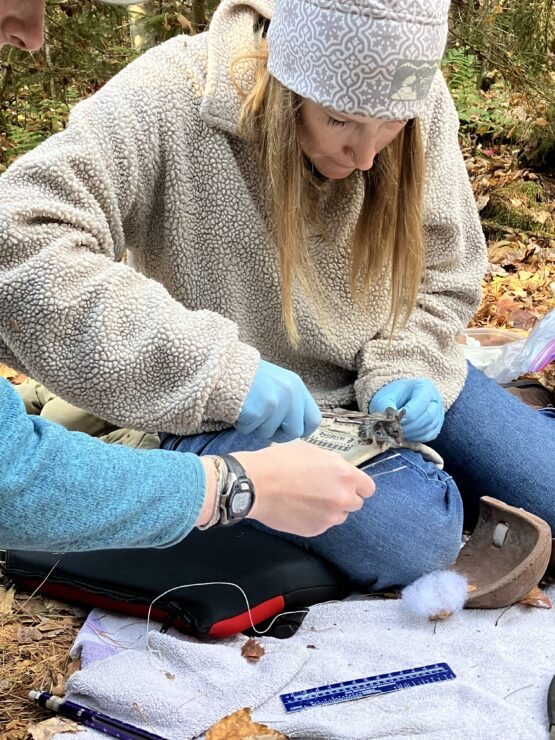 Kelly is committed to applied, interdisciplinary research that engages undergraduates and intersects with ecological forestry, sustainability, and environmental education. As a mentor, educator and researcher, she hopes to cultivate a classroom culture that enables all students to experience a sense of belonging in the life sciences. In her teaching, Kelly emphasizes an active-learning, experiential approach often facilitated by involvement in Course Undergraduate Research Experiences (CUREs) for research projects at both local and national scales. Furthermore, she is actively learning how to develop and incorporate contemplative and service-learning pedagogies into her teaching.
She also serves as an adjunct faculty member within the Environmental Conservation department at the University of Massachusetts, Amherst.
Academic
- Ph.D. Ecology, Evolution and Conservation Biology, University of Nevada, Reno, 2017
- B.S. Conservation Biology, SUNY ESF, 2010
Courses Taught
- FWS 109 Foundations of Fisheries & Wildlife Science
- BIO 210 General Ecology Lab
- ENV 330 Conservation Biology
- FWS 332 Techniques in Fisheries & Wildlife Science
- SCI 495 Science Capstone
Current Focal Projects:
Nocturnal Flight Call Project: Avian migration is a seasonal, bidirectional and long-distance movement that occurs annually for billions of birds between their breeding grounds (summer) and non-breeding areas (winter). Migratory birds are particularly vulnerable to a myriad of threats such as habitat loss, collision with anthropogenic structures, and disease. Their conservation requires greater understanding of seasonal flight patterns; however, this can prove challenging given that migration occurs mostly at night. Nocturnal flight call monitoring is one method that allows us to capture species-specific flight calls of nocturnal migrants through passive recording stations. Our work largely aims to: 1) inventory the species diversity of avian migrants that fly over our campus in the High Peak region of the Adirondack Park in New York State, and 2) examine population trends over time of vulnerable species, and 3) identify any climatic or phenological variables potentially influencing rates of detection.
ADK Wildlife Watch Project: Non-invasive detection of wildlife through the use of trail cameras is an increasingly informative (and fun!) tool. This project aims to expand our understanding of wildlife diversity and distribution on PSC lands and the Visitor Interpretive Center. Furthermore, we are active collaborators with regional trail camera efforts such as the Adirondack Inventory Monitoring project (https://www.adirondackexplorer.org/environment/candid-cameras-scientists-students-collect-images-and-data-of-the-wild/) and Snapshot NY (https://www.snapshotny.org/). By evaluating the temporal rates and spatial scope of detection of wildlife across various habitat types and silviculture treatments, we will be better able to track population trends and guide active management.
Adirondack Flying Squirrel Project: North American flying squirrels are arboreal sciurids capable of gliding between trees thanks to a furred membrane known as a patagium that stretches from their wrist to ankle. There are two currently recognized species in the northeastern U.S.: the northern flying squirrel (Glaucomys sabrinus, NFS) and the southern flying squirrel (Glaucomys volans, SFS). Although each species has distinct habitat preferences, recent range expansions by the SFS have created hybridization zones and concern regarding the potential for extirpation of NFS. While NFS are known to occur in the High Peaks region of the Adirondacks, it is less clear whether SFS are present in this area of the park. This project is focused on: 1) detection of flying squirrel species through genetic testing, 2) monitoring of occupancy and behavior through the use of nest boxes and trail cameras, and 3) evaluation of potential local dialects through the use of acoustic recording units (ARUs).
Small Mammal Monitoring: Small mammals are typically defined as mammals that are non-volant, primary nocturnal, and weigh less than 500 grams. Given their short lifespans and high reproductive rates, small mammals respond rapidly to environmental change which make them ideal bioindicators of ecosystem health. This project aims to 1) establish a long-term monitoring project to understand patterns of small mammal diversity and distribution, and 2) estimate population size for Peromyscus species and understand survival across different habitat types using a mark-recapture framework.
Bird-Window Collisions: Bird-window collisions are a leading cause of anthropogenically-driven bird mortality in the U.S. and Canada, ranking second only to free-ranging domestic cats (Blancher 2013; Loss et al. 2013). Windows are a particularly dangerous material, as they create the illusion of clear airspace. Bird-window collisions are unnecessary and preventable deaths, especially when effective and affordable solutions are available to reduce this risk. See article for more info: https://www.umass.edu/humanities-arts/news/umass-bird-friendly-project
Van Allen, Gwendolyn*, Kelly Klingler, Roxann Cormier, Richard Harper. Investigating Campus Tree Inventories in the Northeastern United States. Journal of Arboriculture, Submitted 9/2/25, In Review
Beever, E.A., Peacock, Mary; Wilkening, Jennifer; Billman, Peter; Ernest, Kristina; Schmidt, Danielle; Klingler, Kelly; Nichols, Lyle… Evaluating strength of evidence and drivers for species-climate relationships, across space and time. Conservation Biology. Submitted 9/1/2025, In Review
Beever, Erik A., Adam B. Smith, David Wright, Tom Rickman, Francis D. Gerraty, Joseph A. E. Stewart, Alisha Gill, Kelly Klingler, and Megan Robinson. 2025. Expanding Barriers: Impassable Gaps Interior to Distribution of an Isolated Mountain-Dwelling Species. Ecosphere 16(6): e70223. https://doi.org/10.1002/ecs2.70223
Berube, J. A., Sirén, A. P., Simpson, B. D., Klingler, K. B., & Wilson, T. L. 2024. Monitoring questing winter tick abundance on traditional moose hunting lands. The Journal of Wildlife Management, 88(6), e22630. https://doi.org/10.1002/jwmg.22630
KB Klingler, LB Nichols, E Hekkala, JAE Stewart and MM Peacock. 2023. Life on the edge – a changing genetic landscape within an iconic American pika metapopulation over the last half century. Peer J,11:e15962 https://doi.org/10.7717/peerj.15962
Beever, E. A., Wilkening, J. L., Billman, P. D., Thurman, L. L., Ernest, K. A., Wright, D. H., …Klingler, KB & Wilson, K. C. 2023. Geographic and taxonomic variation in adaptive capacity among mountain-dwelling small mammals: Implications for conservation status and actions. Biological Conservation, 282, 109942 https://doi.org/10.1016/j.biocon.2023.109942
Borokini, IT, KB Klingler, MM Peacock. 2021. Life in the desert: The impact of geographic and environmental gradients on genetic diversity and population structure of Ivesia webberi. Ecology and Evolution http://dx.doi.org/10.1002/ece3.8389
Dunham-Cheatham SM, KB Klingler, MV Estrada, MS Gustin. 2021. Using a next-generation sequencing approach to DNA metabarcoding for identification of adulteration and potential sources of mercury in commercial cat and dog foods. Science of the Total Environment.
https://doi.org/10.1016/j.scitotenv.2021.146102
Klingler, KB, Parchman T, Ray C, Jahner J and MM Peacock. 2021. Genomic variation in the American pika: signatures of geographic isolation and implications for conservation. BMC Evolutionary Biology. https://doi.org/10.1186/s12862-020-01739-9 DRYAD doi:10.5061/dryad.mcvdncjww
Westover, ML, Lizewski, K, Klingler KB, Smith F. 2020. Isotopic niche of the American pika (Ochotona princeps) through space and time. Canadian Journal of Zoology.
https://doi.org/10.1139/cjz-2019-0212
Dunham-Cheatham, SM, Klingler, KB, Peacock, M, Teglas MB, and MS Gustin. 2019. What is in commercial cat and dog food? The case for mercury and ingredient testing. Science of the Total Environment. https://doi.org/10.1016/j.scitotenv.2019.05.337
Klingler, KB. An integrated investigation of the population genetics, physiological stress and movement patterns in the American pika (Ochotona princeps). Doctoral Dissertation. University of Nevada, Reno; 2017.
Nichols, LB, KB Klingler, and MM Peacock. 2016. American pikas extirpated from the Masonic Mining District. Western North American Naturalist. https://doi.org/10.3398/064.076.0203
Wilkening, JL, Ray, C, Ramsay, N and K Klingler. 2015. Alpine biodiversity and assisted migration: The case of the American pika (Ochotona princeps). Biodiversity Conservancy International. https://doi.org/10.1080/14888386.2015.1112304