
Built on a long-standing Adirondack tradition, forestry education at Paul Smith’s College provides students with a foundation of technical, field-based, applied education that combines theory and practice.
Bachelor of Science / 120 Credits
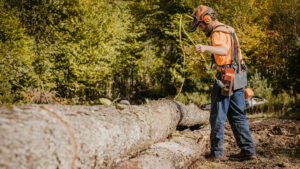
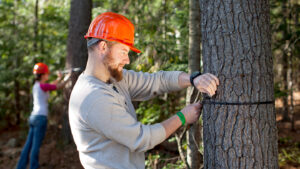
As a forestry major, you’ll complete a rigorous curriculum that’s supported by significant forestry education resources: 14,000 acres of suitability-certified and actively managed forestland, a sawmill and other forestry equipment, a forest manager, expert faculty, a 2,000- tap sugarbush, draft horses, and a rich alumni network.
Bachelor’s degrees are offered in three concentrations:
- Ecological Forest Management prepares students for positions with government forestry agencies, forestry consulting firms and non-governmental organizations.
- Forest Operations is a fit for students interested in working for forest-products companies or running their own forest-products firm.
- Forest Biology is ideal for students who plans to continue to graduate school and specialize in a field such as forest ecology or forest entomology.
All forestry students complete coursework in communications, liberal arts, and sciences to develop an ethic of citizenship and a current mix of marketable professional skills. It’s easy to switch between concentrations during the first year.
 The program, including all concentrations, is accredited by the Society of American Foresters (SAF).
Program Details
- Core Courses
- Dendrology
- Forest Production Processes
- Forest Soils; Forest Management
- Forest Policy
- Advanced Silviculture
- Ecological Forest Management Concentration:
- General Ecology
- Timber Harvesting
- Forest Economics & Finance
- Forest Biology Concentration:
- Plant Biology
- General Ecology
- Organic Chemistry
- Forest Operations Concentration:
- Wood Properties
- Timber Harvesting
- Forest Products
- Consulting Forester
- Field Forester
- Forestry Technician
- Procurement Forester
- Log Buyer
- Forest Products Industry
At the end of the program students will be able to:
- Analyze and synthesize the ecological and biophysical underpinnings of Forests.
- Analyze forestry production cycles.
- Analyze forest inventory and natural resources data, both spatially and non-spatially.
- Develop and express informed perspectives and opinions on the biophysical and sociopolitical contexts in which forestry is practiced.
- Integrate forestry knowledge and experience to develop forestry-related arguments and plans that reflect an appreciation of the diverse uses and values associated with forest resource and their sustainable management.
- Evaluate costs and benefits related to forest resource management.
|
Semester 1 |
||
|
ENG 101 |
Effective College Writing I |
3 |
|
FOR 101 |
Introduction To Forestry |
3 |
|
FOR 110 |
Dendrology |
3 |
|
FYS 101 |
First Year Seminar |
3 |
|
MAT 125 |
Algebra |
3 |
|
Semester 2 |
||
|
FWS 105 |
Introduction to Wildlife Management |
3 |
|
GIS 201 |
Introduction To GIS |
3 |
|
Social Sciences |
3 |
|
|
ENG 102 |
Effective College Writing II |
3 |
|
Semester 3 |
||
|
BIO 110 |
Biology |
3 |
|
FOR 235 |
Timber Harvest |
4 |
|
FOR 241 |
Forest Mensuration II |
4 |
|
FOR 260 |
Silviculture |
3 |
|
Semester 4 |
||
|
ECN 200 |
Principles of Economics |
3 |
|
FOR 280 |
Measurements & Mapping |
3 |
|
FOR 280 |
Woodlot Management |
3 |
|
MAT 210 |
Statistics |
3 |
|
Semester 5 |
||
|
BIO 210 |
General Ecology |
3 |
|
CHM 110 |
Chemistry I |
3 |
|
FOR 231 |
Forest Health |
3 |
|
Elective-UD |
2-4 |
|
|
Semester 6 |
||
|
ENV 340 |
Watershed Science |
3 |
|
FOR 310 |
Forest Ecology |
3 |
|
FOR 350 |
Forest Policy |
3 |
|
FOR 365 |
Forest Economics and Finance |
3 |
|
Elective |
2-4 |
|
|
Semester 7 |
||
|
FOR 330 |
Soils and Hydrology |
4 |
|
FOR 420 |
Advanced Silviculture |
3 |
|
FOR 450 |
Forest Management |
3 |
|
Elective – UD |
3 |
|
|
Semester 8 |
||
|
FOR 495 |
Forestry Capstone |
4 |
|
Liberal Arts Elective-UD |
3-4 |
|
|
Elective – UD |
3-4 |
|
|
Elective – UD |
3-4 |
|
|
Summer Session Between Freshman & Sophomore Years |
||
|
FOR 206 |
Forest Prod. Process |
2 |
|
FOR 204 |
Forest Mensuration I |
2 |
|
SRV 201 |
Field Surveying I |
2 |
Where the Learning Happens
See It for Yourself
Questions? Let's get in touch.
Justin Waskiewicz
Faculty
Associate Professor of Forestry