There’s something distinctive about how Smitties handle adversity. They don’t quit.
Our culinary students thrive when the kitchen gets too hot. Our bass anglers battle high winds and big waves if that’s what it takes to secure first place. We literally offer a course that trains Beginning Exterior Firefighting Operations (BEFO) graduates to operate in Immediately Dangerous to Life or Health (IDLH) conditions at active fire scenes.
Smitties don’t retreat. Quite the opposite—they mobilize, they adapt, they defy the odds, and they rise. And over the past year, that same spirit has defined the College itself. At a time when headlines about higher education are dominated by shrinking enrollments, institutional closures, and fears that AI is taking over, Paul Smith’s College is telling a very different story, one rooted in calloused hands, sharp minds, and an unapologetic commitment to doing. Before we get to the enrollment numbers turning heads across the sector, take a look at what’s been happening in our neck of the woods.
A College Reimagined Through Place and Practice
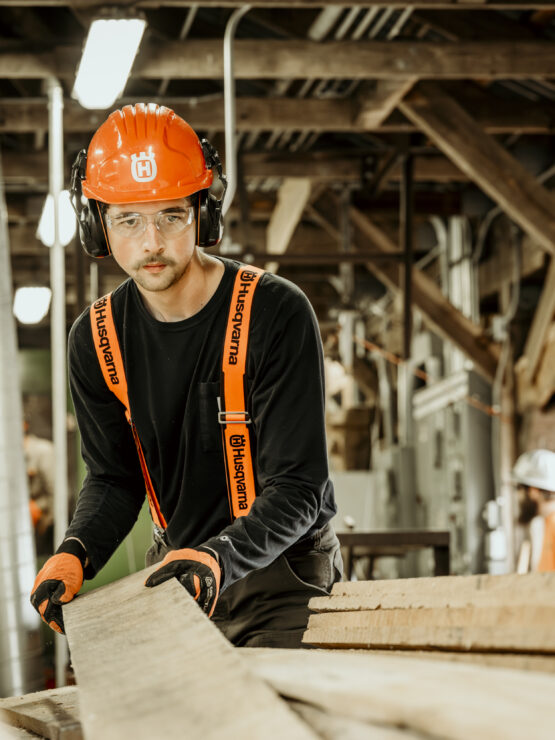 Paul Smith’s College has always been inseparable from its setting: a six-million acre natural classroom where theory meets terrain. Today, that legacy is being reimagined through innovative academic models that blur the line between classroom and career.
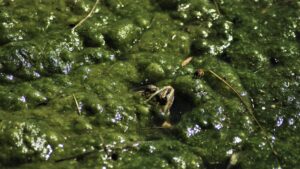
Natural science students aren’t just studying ecosystems, they’re out on the lake collecting wild microbes for active research. Forestry students are transforming freshly harvested timber into finished boards at the only student-run mill in the country. No matter their major, every student finds themselves outside or in professional settings, doing the work.
We’ve also launched bold new initiatives like the VA-endorsed, veteran-focused Battlefish Academy—a first-of-its- kind certificate program that unfolds
across the forests and lakes of the Adirondacks. At the same time, our longstanding institutes continue to deliver real-world experience that simply can’t be replicated elsewhere.
As President Dan Kelting noted in the Adirondack Daily Enterprise, the College operates with a startup mindset: nimble, entrepreneurial, and unburdened by excessive bureaucracy. That agility allows programs to evolve quickly in response to industry needs and emerging challenges.
The result? Smitties graduate with tangible skills, professional confidence, and a deep connection to the work they’re called to pursue.
Building Resiliency for a Changing World
That hands-on approach is also what makes Paul Smith’s College uniquely resilient in an era of rapid technological change.
The College focuses on fields that are deeply human and in high demand, including environmental science, forestry, hospitality, culinary arts, natural resources, fisheries, and wildlife science. These are careers that require judgment, adaptability, and physical presence—qualities that cannot be easily automated.
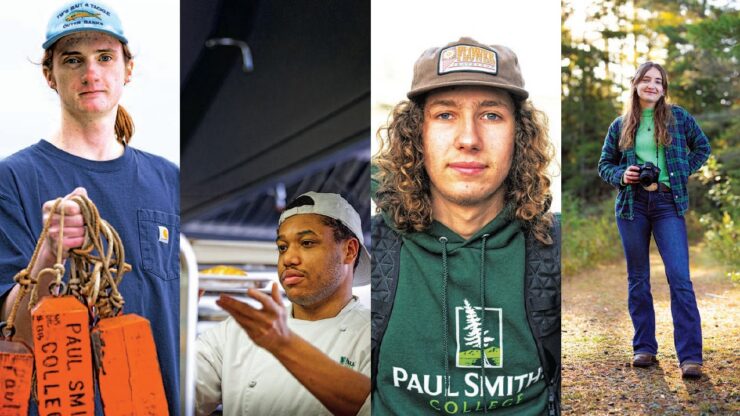
That human-centered focus has earned national attention. Kathy Bonavist, Executive Vice President of Advancement & Enrollment at Paul Smith’s College, told Newsweek: “Paul Smith’s has been around since 1946, and one might argue that we’ve always been relatively AI-proof. Now, we’re just doubling down on it.”
In the same article, one student reflected on the reassurance that comes from preparing for work that large language models can’t easily replace. “AI has its place in the forestry industry, whether it’s in a machine or on a computer. What AI doesn’t have is the human eye and mind,” Gavin Tufo, a sophomore majoring in Arboriculture and Landscape Management, told Newsweek. “No single tree is the same; no conditions or ground environment are exactly the same.”
“AI has its place in the forestry industry, whether it’s in a machine or on a computer. What AI doesn’t have is the human eye and mind.”
Another student, Liam Carroll, shared that he chose Paul Smith’s College for his “love of the outdoors.” Now, he says he’s “relieved that the jobs that I could get with my degree are going to be one of the last things that AI could replace, if at all.”
The pace of AI may be accelerating, but the value of human-centered skills—critical thinking, problem-solving, stewardship, and service—remains constant. Paul Smith’s College is committed to teaching both.
Bucking National Trends
Between 2010 and 2022, four-year private colleges across the country lost roughly 55% of their enrollment. Combined with tightening budgets, rising skepticism about higher education, and a wave of mergers and closures, the outlook for small institutions has been anything but optimistic.
And yet, in fall of 2025, Paul Smith’s College recorded a 30% year-over-year increase in first-time, full-time freshman enrollment, a milestone moment for the College and a powerful counterpoint to the national narrative. Students are arriving from more places, with more purpose, drawn by an education centered on experience.
“Across the country, small colleges are the lifeblood of their regions, anchoring economies, educating local leaders, and sustaining culture. Paul Smith’s is no different,” said Bonavist. “Here, in the middle of a six-million-acre forest,” she adds, “we’ve shown what’s possible when a community of alumni, faculty, staff, and partners matches ambition with action. Together, we’re proving that small, purpose-driven institutions are not relics of the past, but blueprints for the future.”
No, Smitties don’t quit. And as long as we keep believing in the magic of this place, we’ll keep moving forward, ready for whatever comes next.
This article is from the Spring 2026 issue of the Paul Smith’s College Magazine.